



Loose parts for play and movement
Open-ended loose parts for play and movement –
varied movement for healthy postural development
Children nowadays move noticeably less than they need to if they are to develop healthily. According to the World Health Organization, around 80% of 5- to 17-year-olds do not get the recommended level of daily physical activity. Children are increasingly playing indoors, and traditional toys are often only suited to a short stage of development or offer very limited scope for use. Yet getting sufficient movement isn’t optional – it’s a biological necessity. The first few years of life, right through to puberty, are when the foundations are laid for a healthy postural, musculoskeletal and metabolic system.
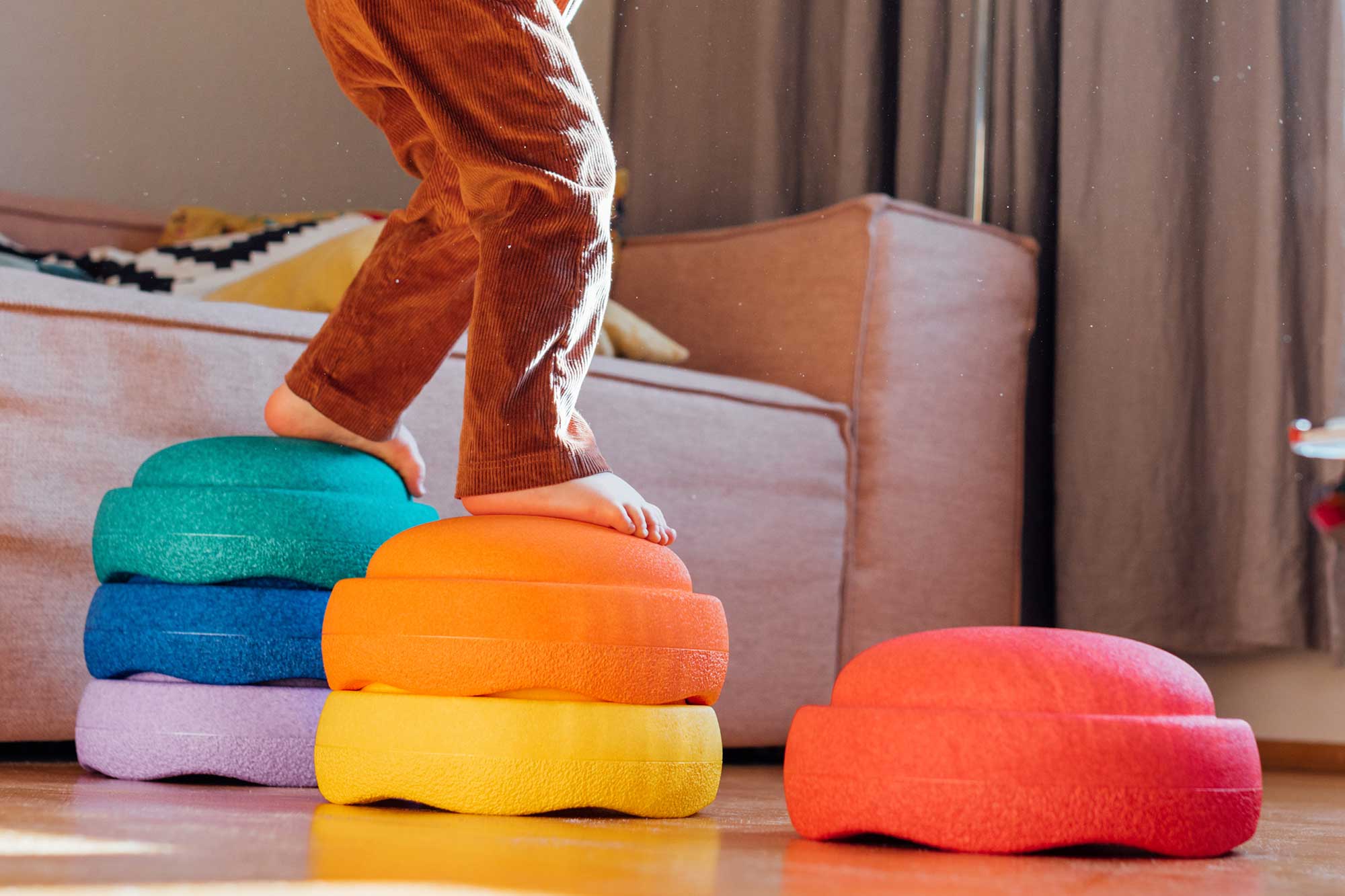
Why free play often achieves more than guided exercises
Muscles, bones, the nervous system and the brain all mature in close interplay with one another during childhood – and this maturing process needs movement-based stimulation. What matters most here isn’t structured activity routines, but varied, self-directed movement through free play. Jumping, balancing, climbing, carrying and supporting weight don’t just activate individual muscles – they engage entire chains of muscles, helping to build joint stability and bone density. The deep core and postural muscles in particular, which are essential for a healthy spine, are activated above all else by changing, dynamic balance needs – not by sitting rigidly still or following fixed activity routines.
Children who don’t get enough movement-based stimulation are more likely to develop muscle imbalances and functional postural weaknesses, which can already be evident by pre-school and primary school age. At the same time, fidgeting, rocking back and forth on a chair or wriggling around aren’t examples of ‘bad behaviour’ – they are an expression of a healthy, biologically rooted need for movement, a signal that the body is craving variety.
Open-ended, not prescribed – why play and movement materials without a fixed use encourage free play
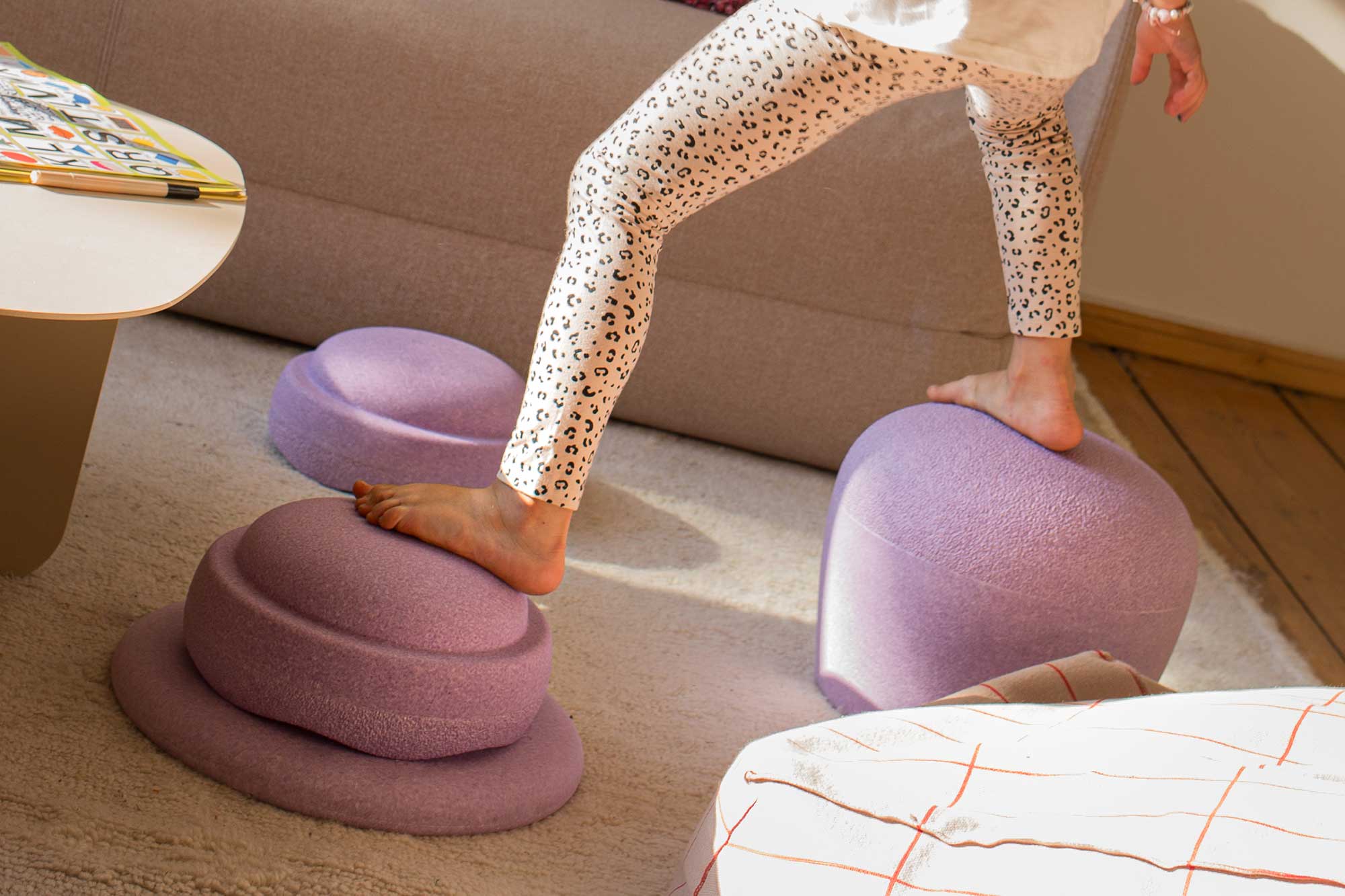
For children to act on this urge to move as part of their everyday life, they need play and movement items that invite movement in themselves, rather than dictating a particular use. Open-ended, modular pieces – such as different sizes of stackable items – are defined by the fact that they don’t offer a single fixed solution. Children decide for themselves whether something becomes an island, a stool, a balance beam or a building block. This very open-endedness is valuable from a developmental psychology perspective, as it requires imagination, problem-solving skills and initiative, while also allowing children of all ages and all levels of physical ability to find the right challenge for themselves.
When well-designed, these items don’t just support the development of motor skills – they support cognitive and social development at the same time, for instance when children plan a course together, negotiate with one another, or work together to stabilise a structure.
- Any loose play and movement materials used must be demonstrably free from harmful substances and pose no harm to health (toxicological safety), for example in line with DIN EN 71 and the REACH and POP Regulations.
- The items should encourage a variety of physical demands on the body – for example through jumping, balancing, carrying or climbing over, as well as heights, sizes and distances that children can adjust by themselves.
- Movements should challenge several joints and muscle groups all at once (requiring movement of multiple joints) – through different ways of supporting, pushing off and jumping, and by incorporating domed and hollowed surfaces (convex and concave shapes).
- Keeping balance while moving should be a core part of play (dynamic balance situations) – for example, balancing on surfaces of varying height, wobbly or gently shifting ground, and sitting dynamically on seating that moves.
- Loose parts should effectively engage the sense of balance and body position (vestibular and proprioceptive stimuli) – for example, through turning, tilting and changing position, or by frequently switching between lying down, sitting and standing.
- The demands placed on the muscles and the nervous system (neuromuscular demands) should be scalable to suit children – by means of adjustable heights and distances, plus movements where children make use of their own body weight rather than external added weights.
- Play should encourage children to experiment and solve problems for themselves (motor planning) by using their imagination to freely design movement landscapes and creative building phases, for example.
- Play should be free and self-directed, without any pressure to perform (exploratory play) – with open-ended tasks, several possible solutions and no fixed scoring systems.
- Children should be able to decide for themselves how strenuous or challenging their movement is, for example by freely choosing the height, pace and risk, with no obligatory number of repetitions.
- A variety of postures (such as crouching, kneeling, lying down, squatting, standing or balancing) should be possible and encouraged – not to mention height-adjustable and movable sitting facilities.
- Play should engage movement, perception, thinking and social interaction all at once, for example through playing together with children of different ages, which requires negotiation and exchange.
Minimum requirements
- Materials that are demonstrably free from harmful substances
- Items that encourage a variety of movements (jumping, balancing, carrying, climbing over)
- Movements that engage several joints and muscle groups at the same time
- Situations requiring children to repeatedly regain their balance
- Stimulation for the sense of balance and body position
- Demands on muscles and the nervous system that are scalable to suit children
- Encouragement to experiment and solve problems for themselves
- Open-ended, free play with no pressure to perform
- Self-directed choice of effort and pace
- A variety of postures
- Support for movement, perception, thinking and social interaction all at the same time


Stapelstein GmbH
Langwasen 7
72417 Jungingen
Germany
www.stapelstein.de/en
More from the World of Backs
AGR certified products
for every area of life

Children’s products with the
AGR seal of approval
