



Chairs for kindergarten teachers
Ergonomic chairs for early years practitioners – noticeable relief for demanding day-to-day work in a childcare setting
Early years practitioners are exposed to high levels of mental and organisational stress in their day-to-day work. Noise, time pressure, staff shortages, constant interruptions and emotional challenges often lead to stress, exhaustion and increased absenteeism – but back pain and problems in the hip and knee areas shouldn't be underestimated either.
As an early years practitioner, you work in an environment that is completely focused on children every day. Low tables, small chairs, activities at floor level and frequent bending are part of your everyday experience. The result: back pain, tension and increasing discomfort in your knees and hips. Many early years practitioners say that physical strain increases steadily throughout the day and can, over time, lead to serious musculoskeletal disorders.
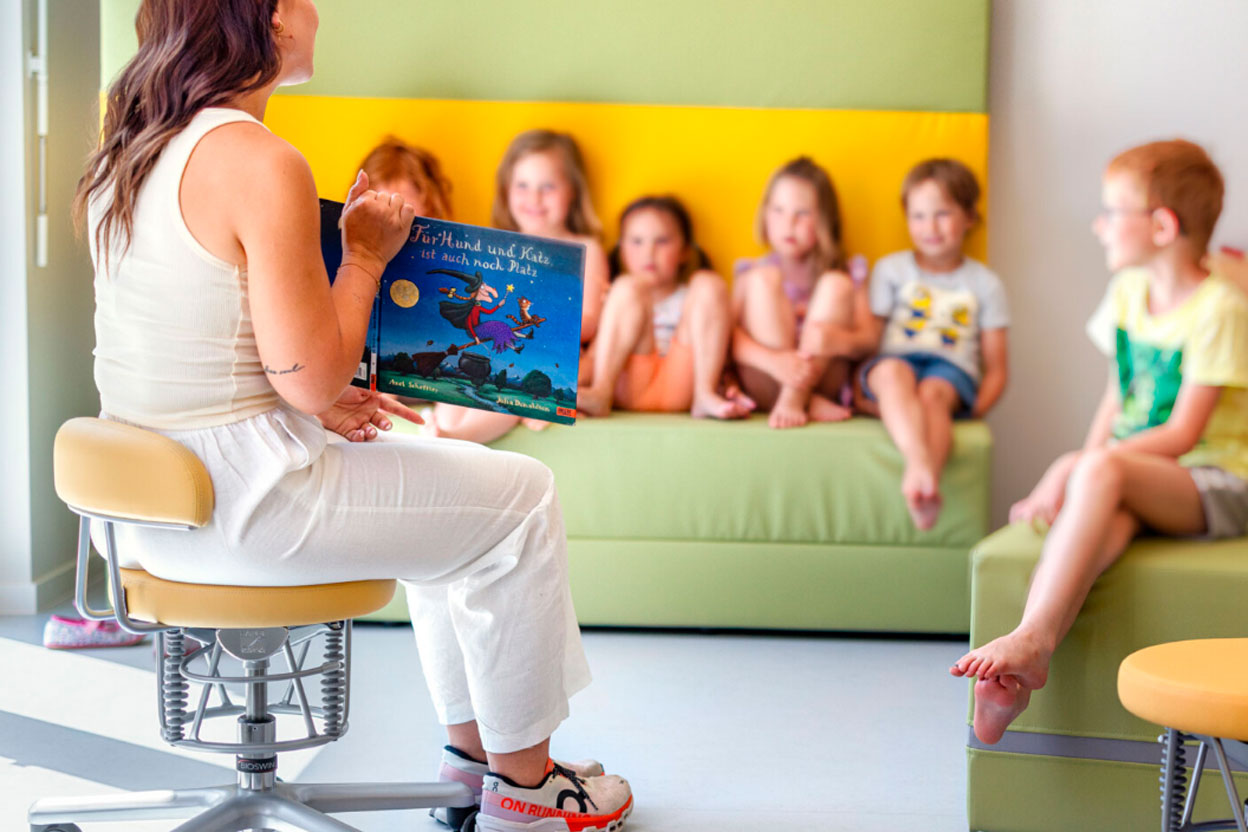
An ergonomic chair designed specifically for use in nurseries and other early years settings can make a big difference here. It provides support for your back, relieves pressure on your joints and helps to significantly reduce the strain experienced day-to-day in childcare environments.
Why an ergonomic chair for early years practitioners is so important: Back-friendly working – natural posture support
An ergonomic seat that allows for light movement helps you to maintain a natural, upright posture. Dynamic sitting keeps your back muscles active, relieves tension and provides lasting relief for your spine. It effectively prevents back problems, which is essential for healthy working practices in a nursery or preschool environment.
Flexible height adjustment for every work scenario
Working in an early years setting involves constantly switching between different tasks and heights. One moment you might be interacting with children at eye level, the next you could be working at a desk or taking care of organisational tasks. A chair with extensive height adjustment enables precisely this kind of fluid transition – without having to bend down low, crouch or resort to unsuitable children's chairs. It noticeably reduces strain on your back and makes awkward bending a thing of the past.
Sustainable relief for knees and hips
Working on the floor or in a very low position quickly leads to strain on the knee and hip joints. An ergonomic chair that accommodates for low seat heights and offers flexibility of movement protects your joints and ensures a significantly more comfortable working position. You get to work in a more relaxed way, with less strain on your joints, and can prevent problems in the long term.
Safe, mobile and suitable for everyday use
A good early years practitioner chair needs to be lightweight, stable and tip-proof so that you can move flexibly in your learning environment. Castors that are suitable for the type of floor you have make it easier to move around without compromising safety. A compact design also allows you to sit down close to child-sized tables while still maintaining an ergonomic sitting position.
Healthy working in child care settings – with an ergonomic seating solution
An ergonomic chair can't completely eliminate physical strain in a nursery or preschool classroom, but it is a key tool for significantly reducing back pain, musculoskeletal disorders and knee and hip problems. The right seating solution allows you to work in a back-friendly way, stay mobile and support your health long term.
A chair that meets the criteria of Aktion Gesunder Rücken offers you exactly that: noticeable relief, optimal support and ergonomic working – day after day in your early years setting.
- To prevent avoidable accidents in the hustle and bustle of everyday nursery or preschool life, chairs need to have been tested for safety. For example, they might carry the German GS (Tested Safety) mark, which shows that they remain safe and stable even during rapid movement.
- Because early years practitioners are constantly turning, twisting or moving spontaneously around children, the chair needs to be easily movable and have suitable castors so that it can effortlessly accommodate sudden changes of direction – for example, when turning quickly to help a child who needs assistance.
- To avoid tension and a rigid seated position, the seat should move with you and cushion movements so that your spine remains active and relieved with every small shift in weight, similar to if you gently rock on a well-balanced stool.
- The seat should be softly contoured and rounded to prevent uncomfortable pressure points and restricted blood circulation in the thighs. This is particularly beneficial for activities that involve frequent bending forwards and backwards, as is the case when doing crafts with children.
- To make quick transitions between low children's work surfaces and activities at adult height level backfriendly, the chair needs to be easy and intuitive to adjust within a sufficiently broad height range. You might, for example, be sitting at an activity table one moment and then at a meeting table the next.
- For the chair to remain stable even when moving sideways, reaching for materials or sitting with children at eye level, it needs to have a wide, tip-proof base – something that provides particular safety if a child briefly uses the chair for support when standing up.
- Because complicated lever mechanisms are usually ignored in everyday nursery and preschool life, all control elements need to be accessible and simple to use so that they can be operated quickly, even in the middle of an activity, e.g. when you need to spontaneously adjust the seat height to help a child get dressed.
- Functional pelvic support is needed to automatically promote an upright sitting posture and to prevent the pelvis from tilting backwards and creating a rounded back. This is important even when sitting down briefly between two activities, such as when changing nappies or comforting a child.
- To avoid subjecting the spine to harsh impact when sitting down quickly or frequently, the chair needs to have effective cushioning – this is particularly helpful when you need to sit down quickly because a child wants to show you something.
- Optional
- If activities require a leaned-back sitting posture for long periods of time, e.g. during a meeting or administrative work, an ergonomic backrest can help you sit in a relaxed and pressure-free position.
- To make sure the chair meets the hygiene requirements of everyday nursery or preschool life, the materials should be easy to clean – something that's especially relevant when children get paint, sand or glue on their hands.
Optional
- If activities require a leaned-back sitting posture for long periods of time, e.g. during a meeting or administrative work, an ergonomic backrest can help you sit in a relaxed and pressure-free position.
- To make sure the chair meets the hygiene requirements of everyday nursery or preschool life, the materials should be easy to clean – something that's especially relevant when children get paint, sand or glue on their hands.
Minimum requirements
- Verifiable safety
- Flexible adaptability to different activities
- Dynamic relief of the spine
- Pressure-free sitting
- Extensive seat height adjustment
- Secure upright position
- Easy-to-use functions
- Effective pelvic support
- Cushioned, back-friendly sitting
Optional criteria
- Backrest
- Easy-care materials


Haider Bioswing GmbH
Dechantseeser Str. 4
95704 Pullenreuth
GERMANY
Phone +49 9234/99 22-0
Fax +49 9234/99 22 166
www.bioswing.de

Sedus Stoll AG
Christof-Stoll-Str. 1
79804 Dogern
GERMANY
Phone +49 7751/84 300
Fax +49 7751/84 61 300
www.sedus.com


